India need to win both their remaining matches against Bangladesh (June 25) and Australia (June 28) to guarantee a semi-final spot at the ICC Women’s T20 World Cup 2026. After a six-wicket loss to South Africa on June 21, the Women in Blue sit second in Group A on 4 points with a net run rate (NRR) of +2.511.
Meanwhile, three teams, India, South Africa, and Bangladesh, are all locked on 4 points with two matches left. As a result, Australia lead the group comfortably with 6 points and an NRR of +4.391 after three comprehensive wins. Consequently, the final week of the group stage will decide which two teams from Group A book their tickets to The Oval for the knockouts.
Group A Points Table (After Round 3)
Before breaking down the qualification paths, here is where every Group A team stands after three rounds of matches. The table below is updated as of June 22, 2026.
| Team | M | W | L | Pts | NRR | Status |
|---|---|---|---|---|---|---|
| Australia | 3 | 3 | 0 | 6 | +4.391 | Almost qualified |
| India | 3 | 2 | 1 | 4 | +2.511 | In contention |
| South Africa | 3 | 2 | 1 | 4 | -0.546 | In contention |
| Bangladesh | 3 | 2 | 1 | 4 | -0.641 | In contention |
| Pakistan | 3 | 0 | 3 | 0 | -1.857 | Eliminated |
| Netherlands | 3 | 0 | 3 | 0 | -3.384 | Eliminated |
As things stand, Australia are in cruise control, while the real battle is between India, South Africa, and Bangladesh for that second semi-final berth. Meanwhile, Pakistan and Netherlands are already out after three straight losses each.
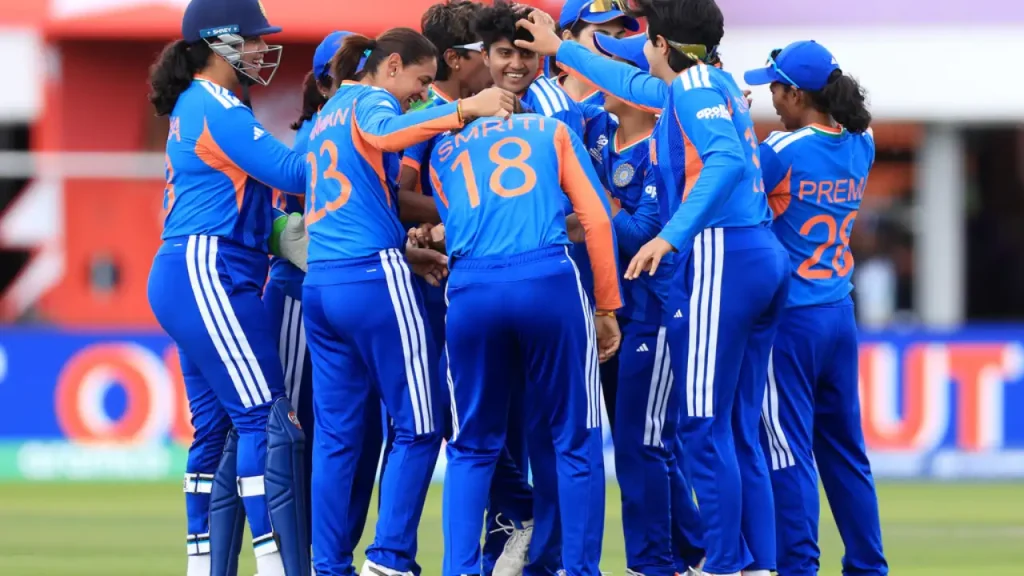
India’s Results So Far in the Tournament
The reigning ICC Women’s Cricket World Cup champions started their T20 World Cup campaign on a high note. However, the loss to South Africa in Round 3 has changed the group dynamics significantly.
| Date | Match | Venue | Result | Margin |
|---|---|---|---|---|
| June 14 | India vs Pakistan | Edgbaston, Birmingham | Won | By 64 runs |
| June 17 | India vs Netherlands | Headingley, Leeds | Won | By 95 runs |
| June 21 | India vs South Africa | Old Trafford, Manchester | Lost | By 6 wickets |
Notably, India posted 200+ against Netherlands, the first time they crossed that mark at a Women’s T20 World Cup. As a result, their opening victories over Pakistan and Netherlands were dominant enough to build an NRR cushion of +2.511, which now acts as their safety net.
In contrast, the South Africa loss exposed cracks. Marizanne Kapp’s unbeaten 81 off 45 balls chased down India’s total with relative ease, and moreover, dropped catches cost Harmanpreet Kaur’s side dearly.
India’s Remaining Matches in Group A
Two matches remain for India, and both carry knockout-level stakes. Here are the fixtures that will decide their fate.
| Date | Match | Venue | Time |
|---|---|---|---|
| June 25 | Bangladesh vs India | Old Trafford, Manchester | 7:00 PM IST |
| June 28 | India vs Australia | Lord’s, London | 7:00 PM IST |
In particular, the Bangladesh match on June 25 is, for all practical purposes, a virtual quarter-final. Specifically, a loss there would hand Bangladesh 6 points and leave India on just 4, adding immense pressure on the final match against Australia.
Furthermore, the India vs Australia clash on June 28 at Lord’s could turn into a Group A decider. Australia have been ruthless so far, so consequently, India will need their best cricket on the biggest stage.
India’s Qualification Scenarios Explained
Here is a scenario-by-scenario breakdown of what each combination of results means for India’s semi-final qualification hopes.
Scenario 1: India Win Both Remaining Matches
Result: India qualify for the semi-finals (confirmed).
This is the cleanest path. Two wins would take India to 8 points from five matches. Since Australia can also reach 8 or 10 points, and only two teams qualify from the group, India finishing on 8 would place them comfortably in the top two.
Moreover, even if South Africa win their remaining two games (vs Netherlands and Bangladesh) to reach 8 points, India’s NRR of +2.511 is significantly better than South Africa’s -0.546. Therefore, India would still finish ahead in that scenario.
Bottom line: win both, book the ticket, and avoid the calculator. Simple.
Scenario 2: India Beat Bangladesh, Lose to Australia
Result: India very likely qualify, but NRR could become a factor.
A win over Bangladesh on June 25 followed by a loss to Australia on June 28 would leave India on 6 points. At the same time, Australia would reach 10 points and top the group.
For India to miss out in this scenario, however, South Africa would need to win both their remaining matches and finish on 8 points. That would consequently push India to third on the table, which means elimination.
However, if South Africa drop even one match, India’s 6 points and superior NRR would be enough. Given South Africa’s games are against Netherlands and Bangladesh, a Bangladesh upset is not impossible.
In addition, if India lose narrowly to Australia and protect their NRR, they would stay ahead of South Africa and Bangladesh even at 6 points, assuming those teams also finish on 6. India’s current NRR advantage of over 3 points compared to South Africa provides a comfortable buffer.
Scenario 3: India Lose to Bangladesh, Beat Australia
Result: India qualify, but the equation gets messy.
If India lose to Bangladesh but then beat Australia, they would again finish on 6 points. Beating Australia, however, would mean Australia could also drop to 6 or 8 points depending on the Pakistan game.
In this scenario, consequently, Bangladesh would move to 6 points as well. Then it becomes a three-way race between India, Bangladesh, and potentially South Africa, all at 6 points. Ultimately, NRR would decide the final standings.
India’s current NRR of +2.511 gives them a strong buffer. Unless they suffer heavy defeats, they would likely stay ahead of both Bangladesh (-0.641) and South Africa (-0.546). This scenario is survivable but comes with anxiety.
Scenario 4: India Lose Both Remaining Matches
Result: India are most likely eliminated.
Two losses would leave India stranded on 4 points from five matches. South Africa play Netherlands and Bangladesh in their remaining fixtures. If the Proteas win both, they reach 8 points and qualify alongside Australia.
Similarly, even if South Africa stumble, Bangladesh’s wins over India and potentially South Africa could take them past India on points. With just 4 points, India would need multiple results to go their way, and the probability is slim.
In short, two losses effectively end India’s tournament. The 2024 edition saw India crash out in the group stage, and a repeat would be a bitter pill for a team that won the ODI World Cup at home just months ago.
Quick Qualification Summary
| Scenario | Points | Outcome |
|---|---|---|
| Win vs BAN + Win vs AUS | 8 | Qualified (confirmed) |
| Win vs BAN + Lose vs AUS | 6 | Very likely qualified on NRR |
| Lose vs BAN + Win vs AUS | 6 | Likely qualified (NRR dependent) |
| Lose both matches | 4 | Almost certainly eliminated |
How the Net Run Rate (NRR) Tiebreaker Works
When two or more teams finish level on points, the ICC uses Net Run Rate as the primary tiebreaker. NRR matters just as much as winning in tight group races, which is exactly why teams chase down totals quickly instead of coasting.
According to the ICC’s official tiebreaker rules, the hierarchy goes like this:
| Priority | Tiebreaker | Explanation |
|---|---|---|
| 1st | Net Run Rate (NRR) | Difference between runs scored per over and runs conceded per over across all group matches |
| 2nd | Head-to-Head Result | If NRR is identical, the result of the match between the tied teams decides |
| 3rd | ICC T20I Rankings | If all else fails, team rankings at the start of the tournament are used |
Notably, India’s NRR of +2.511 is the second-best in Group A behind Australia’s +4.391. Compare that to South Africa (-0.546) and Bangladesh (-0.641), and India hold a massive advantage of over 3 points in NRR. Therefore, even a narrow defeat in one match would not wipe out this cushion entirely.
This is why India’s dominant wins over Pakistan (64-run margin) and Netherlands (95-run margin) in the early rounds were so important. Those big victories created a buffer that could prove decisive in the final reckoning.
Can South Africa or Bangladesh Knock India Out?
Yes, both teams absolutely can. While India hold the advantage right now, the remaining fixtures create multiple permutations where either rival could leapfrog them.
South Africa’s Path to the Semi-Finals
South Africa (4 points, NRR -0.546) beat India on June 21 and have momentum on their side. Their remaining matches are against Netherlands (June 25) and Bangladesh (date TBD).
If the Proteas win both games by big margins, they could finish on 8 points and qualify regardless of India’s results. Against Netherlands, who have lost all three matches by wide margins, a comprehensive win looks achievable.
The catch, however, is that South Africa’s NRR sits deep in the negatives thanks to that 65-run opening loss to Australia. As a result, they will need heavy victories to drag it into positive territory. Still, a win over India has given them belief, and Marizanne Kapp has been in sensational form.
Bangladesh’s Path to the Semi-Finals
On the other hand, Bangladesh (4 points, NRR -0.641) are the dark horses of Group A. They have already beaten Netherlands and also pulled off a stunning 23-run win over Pakistan after restricting them from 49/1 to 100/8.
Their remaining matches against India (June 25) and South Africa are both tough. But if Bangladesh beat India, they move to 6 points and knock the Women in Blue into a vulnerable position.
Spinners Sanjida Akter Meghla and Nahida Akter have been excellent, sharing six wickets against Pakistan. If they replicate that kind of performance against India’s strong batting lineup, an upset is very much on the cards.
In the most dramatic scenario, Bangladesh could beat both India and South Africa to finish on 8 points and qualify directly. That would send shockwaves through the tournament.
Remaining Group A Fixtures That Impact India
It is not just India’s own matches that matter. Several other Group A fixtures can shift the equation. Here is a complete list of remaining games.
| Date | Match | Venue | Impact on India |
|---|---|---|---|
| June 23 | Australia vs Pakistan | Headingley, Leeds | Low |
| June 25 | Bangladesh vs India | Old Trafford, Manchester | Critical |
| June 25 | Netherlands vs South Africa | Bristol | Medium |
| June 27 | Netherlands vs Pakistan | Bristol | Negligible |
| June 28 | India vs Australia | Lord’s, London | Critical |
First, the Australia vs Pakistan match on June 23 is significant primarily for Australia’s qualification, not India’s. Since Pakistan are already eliminated, an Australian win is expected and would take them to 8 points.
Meanwhile, the Netherlands vs South Africa match on June 25 is worth watching closely. A Netherlands upset (unlikely but not impossible in this tournament) would deal a massive blow to South Africa’s ambitions and effectively clear India’s path.
Why India vs Bangladesh Is a Virtual Knockout
Out of all the remaining fixtures, the India vs Bangladesh match on June 25 carries the most weight for India’s qualification.
A win takes India to 6 points and keeps them in a commanding position. A loss, on the other hand, drops India into a precarious spot where they would need to beat Australia and then rely on NRR or other results.
Bangladesh are not pushovers. They are riding the confidence of a stunning victory over Pakistan, and their spin-heavy bowling attack thrives in English conditions where the ball grips and turns.
For India, this match is also a chance to settle the middle-order concerns that surfaced against South Africa. The batting lineup failed to capitalise on a strong powerplay start in that game, and the dropped catches in the field compounded the damage.
Think of it this way: if India beat Bangladesh, they can even afford to lose to Australia and still qualify in most scenarios. If they lose to Bangladesh, even a win over Australia may not be enough. That makes June 25 the pivotal date on India’s calendar.
Australia’s Role in India’s Qualification
Six-time champions Australia have been the most dominant team in Group A. Their wins over South Africa (65 runs), Bangladesh (9 wickets), and Netherlands (98 runs) highlight their all-round strength.
If Australia beat Pakistan on June 23, they will reach 8 points and virtually seal the top spot. That would make the India vs Australia match on June 28 a contest where Australia may have nothing to lose, while India could have everything to play for.
However, if India have already beaten Bangladesh by then, the Australia match becomes less of a must-win. In fact, India could qualify on 6 points with a superior NRR even if they lose to Australia, provided South Africa don’t also reach 8 points.
The flipside is equally true. If Australia somehow lose to Pakistan (a highly unlikely result), the group wide open even further. That scenario would mean Australia enter the India game needing a win themselves, raising the stakes to a level rarely seen in group-stage cricket.
What Happened When India Lost in the Group Stage Before?
This is not the first time India have faced a group-stage scare at the Women’s T20 World Cup. Here is a quick history lesson for context.
For instance, in 2024, India were eliminated in the group stage itself after losing two of their four matches. That exit stung especially hard because India had reached the semi-finals in both 2018 and 2023.
In contrast, the 2020 edition was a different story. India lost to Australia in the final but had topped their group with a perfect record. As a result, the current team carries the scar of 2024 and the belief of the 2025 ODI World Cup triumph.
History suggests that one loss in the group stage is recoverable. Two losses, though, have almost always meant an early exit. That pattern makes the Bangladesh match even more significant.
Final Verdict: India’s Qualification Totally Depends on their own Performance
India’s T20 Women’s World Cup 2026 qualification is very much in their own hands. Win both remaining matches, and the semi-final ticket is booked. Win even one, and NRR should carry them through in most scenarios.
Therefore, the Bangladesh match on June 25 is the immediate priority. Treat it like a knockout, because that is exactly what it is. Consequently, a strong performance there will set up the Australia clash as either a formality or a bonus, rather than a do-or-die contest.